
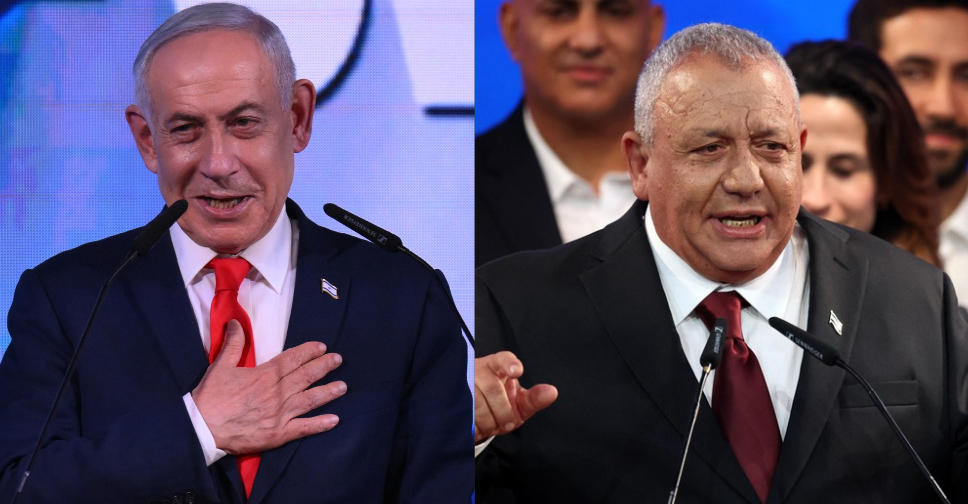
Benjamin Netanyahu looked set to remain Israel's caretaker prime minister after unexpectedly strong backing among Jewish voters left his opponents' little apparent prospect of unseating him, despite his right-wing bloc losing its parliamentary majority.
With nearly 86 per cent of votes tallied on Wednesday, Israel's three main broadcasters projected Netanyahu's bloc of right-wing, far-right and ultra-Orthodox parties would win 53 seats in the 120-seat Knesset, well ahead of the 48 for rival Gadi Eisenkot's opposition bloc.
Parties representing Arab Israelis were projected to win an unprecedented 19 seats, leaving Eisenkot little realistic path to power without their broad backing, which many Jewish political leaders reject.
The results could still change as counting continued, but Eisenkot's bloc of anti-Netanyahu parties, ranging from the centre-left to the hard right, had fallen short of pre-election polls that forecast a tight race.
Netanyahu would remain caretaker prime minister during any coalition negotiations and potentially until another election next year.
While a caretaker government faces some constraints, experts say it retains powers, including over the war with Iran.
Guy Lurie, a research fellow at the Israel Democracy Institute, said a caretaker government formally had the same powers as a regular government, but also "a duty of restraint" and less discretion in some areas.
SECURITY FIGHT SHARPENS
Netanyahu, addressing his Likud party's faithful after 3:00 AM (0100 GMT), called for the formation of "a strong, right-wing national government."
He highlighted Israel's military successes and raised the prospect of renewed joint military action against Iran alongside his ally, US President Donald Trump, saying the two countries had a "singular historical opportunity" to remove what he called the Iranian threat "once and for all."
Trump said Netanyahu had done "very well" and claimed his endorsement had "helped him a lot."
Eisenkot acknowledged that Netanyahu remained caretaker prime minister but warned that he might use security for political ends.
"I call on the heads of the security establishment and the civil service: Netanyahu is a caretaker prime minister, without a mandate or the people's trust," he said. "Stand firm in the face of any attempt to challenge you."
DECISIVE SHIFT IN ISRAELI POLITICS
The result underscored the rightward shift during Netanyahu's years as the country's dominant political figure. The centre-left that dominated Israel for the first half of its history has been reduced to a small fringe.
The election was Israel's first since Hamas-led fighters killed 1,200 people and took 251 hostages in attacks on October 7, 2023, that plunged the country into wars in Gaza, Lebanon and Iran.
The war in Gaza, which flattened the territory and killed 74,000 Palestinians, according to Gaza health authorities, has left Israel increasingly isolated on the world stage.
Netanyahu himself is wanted by the International Criminal Court in The Hague on war crimes charges he calls absurd, and faces corruption charges in Israel that he dismisses as an establishment plot.
Turnout reached 77.7 per cent, the highest in more than two decades, and was particularly high among Israelis of Palestinian descent, who make up more than a fifth of the population.
Many were motivated by what they see as open racism from Netanyahu's cabinet, which includes a party leader convicted of inciting racial hatred against Arabs.
The headquarters of the Joint List, an alliance of several Arab parties, burst into whistles and applause when exit polls were released. "We refuse the occupation and racism, and we will remain here," said Joint List candidate Faten Gattas.
The coalition that last toppled Netanyahu relied on one small Arab party, but Eisenkot's underperformance means the opposition would now need backing from the Joint List itself.

 At least 68 people killed in Spain after two high-speed trains collide
 Syria says main border crossing with Jordan to resume operations on Wednesday
 Policeman kills knife attacker outside Israeli embassy in Serbia
 Three killed, thousands evacuated as Cyclone Arnab hits eastern India