


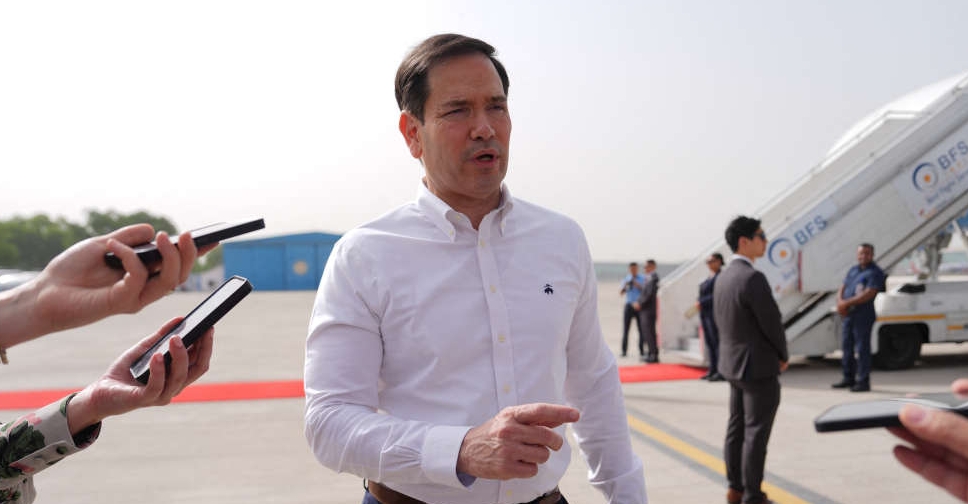
Iran and the US played down hopes for an imminent breakthrough in efforts to end their three-month-old war on Monday, with Secretary of State Marco Rubio saying Washington will either get a good agreement or deal with the country in "another way".
Speaking to reporters in New Delhi, Rubio said the US would give diplomacy every chance to succeed before exploring "alternatives", after President Donald Trump said on Sunday he had told his representatives not to rush into any Iran deal.
There was a "pretty solid thing on the table in terms of their ability to open up the strait, get the strait (of Hormuz) open, enter into a very real, significant, time-limited negotiation on the nuclear matter, and hopefully we can pull it off," Rubio said.
Iran's foreign ministry spokesperson Esmaeil Baghaei said in a weekly briefing on Monday that a conclusion had been reached on many topics, but that does not mean that "we're close to signing an agreement".
The potential memorandum of understanding contains 14 points and is focused on ending the war and the US naval blockade of the Strait of Hormuz, in exchange for Iran taking steps to ensure safe transit through the strategic waterway, he said.
At present the talks are not on the nuclear issue, which will be negotiated over a 60-day period if the framework accord is agreed, Baghaei said.
Trump has said his key aim in the war is to prevent Iran from developing a nuclear weapon with its highly enriched uranium. Tehran has consistently denied it has any plans to do so.
A day earlier, Trump wrote on Truth Social that the US blockade on Iranian ships in the Strait of Hormuz would "remain in full force and effect until an agreement is reached, certified, and signed".
STICKING POINTS
Trump raised expectations of an imminent deal on Saturday when he said Washington and Tehran had "largely negotiated" a memorandum of understanding on a peace agreement that would reopen the strait.
Baghaei said the potential accord contained no specific details on management of the strait, through which about a fifth of the world's oil and liquefied gas flows.
Iran will not charge tolls for ships to pass through the strait, Baghaei said. However, he added there would be a cost for services that will be offered, such as navigation and steps to protect the environment, under a protocol to be agreed with Oman, which shares the opposite shore of the waterway.
The strait has been effectively closed since the start of the war on February 28 with only a trickle of vessels passing through compared with about 125 to 140 daily before the conflict.
Its closure has caused a spike in oil prices and triggered an energy crisis, which has driven up costs of fuel, fertiliser and food.
Oil prices fell 5 per cent to two-week lows on Monday, as optimism grew that the US and Iran were moving closer to a peace deal.
The two sides remain at odds on several difficult issues, such as Iran's nuclear ambitions, Israel's war in Lebanon with Hezbollah and Tehran's demands for the lifting of sanctions and the release of tens of billions of dollars of Iranian oil revenues frozen in foreign banks.
Iranian sources had told Reuters that in future stages, "feasible formulas" could be found to resolve the dispute over its highly enriched uranium stockpile, including diluting the material under the supervision of the UN nuclear watchdog.
TENUOUS CEASEFIRE
Trump, whose approval ratings have been hit by the war's impact on US energy prices, and who has faced congressional efforts to curb his war powers, has repeatedly played up the prospect of a deal to end the conflict started by the US and Israel.
A tenuous ceasefire has held since early April.
The president hit back at critics of his handling of the negotiations and his willingness to compromise with Iran.
"If I make a deal with Iran, it will be a good and proper one... So don’t listen to the losers, who are critical about something they know nothing about," Trump posted on Sunday.
The US-Israeli bombing of Iran killed thousands of people in Iran before it was suspended in early April.
Israel has also killed thousands more and driven hundreds of thousands from their homes in Lebanon, which it invaded in pursuit of Hezbollah. Iranian strikes on Israel and neighbouring Gulf states have killed dozens.

 Thousands stranded at Japan's Narita airport after record rain kills four
 Three killed, 17 injured in Cairo mall helium cylinder explosion
 US to apply economic measures 'never seen' on Iran, says Treasury Secretary
 Blast at Rotterdam port energy facility kills one person