


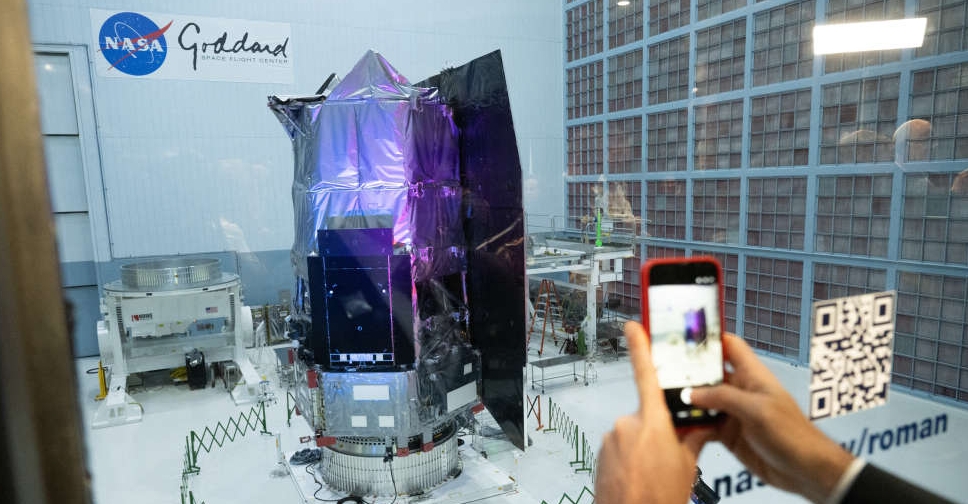
Even before the Nancy Grace Roman Space Telescope has reached its planned orbital position, NASA says its newest flagship observatory's potential operational lifespan may reach 22 years — more than double the length previously announced.
Before its launch last month, the US space agency had said Roman was designed for a five-year primary mission, plus a five-year extended mission, with a 10-year fuel budget in total.
But NASA said the telescope may be able to extend its work thanks to the accuracy of its first mid-course correction en route to its eventual orbital position, anticipated results from its upcoming second mid-course correction and orbital insertion, and extra fuel added prior to the launch.
The telescope was carried into space aboard a SpaceX Falcon Heavy rocket on August 30 in a launch from Cape Canaveral, Florida, on a mission to investigate some of the biggest mysteries in astrophysics and cosmology. "As a result of exquisite planning by our orbital dynamics team, brilliant execution by the operations team and a precise launch from SpaceX, Roman has fuel for at least 22 years of potential science operations," Jamie Dunn, center director at NASA's Goddard Space Flight Center in Maryland, said in a NASA blog post this week.
Roman is travelling through space toward an orbital location called Lagrange Point 2, or L2, situated about 1.6 million km from Earth. "A spacecraft's mass changes throughout the design and build process, so we base the propellant budget on a set maximum value so we won't come up short," Alison Rao, the Roman propulsion lead at NASA Goddard, said in the blog post.
"We track the propellant needed based on actual mass throughout integration and testing as well, to make sure we have wiggle room. Since Roman's was lower than we budgeted for, we were able to fill the propellant tanks to their capacity rather than only filling them as much as we needed to for the 10-year requirement," Rao said.
In addition, NASA said the telescope's first course correction maneuver required less than 10 per cent of the fuel the agency had budgeted for.
The telescope is designed to investigate cosmic enigmas such as dark energy and dark matter, while also testing gravity at vast scales and searching for exoplanets, as planets beyond our solar system are called. Roman will build on the capabilities of other orbiting observatories such as the James Webb Space Telescope, launched in 2021, and the Hubble Space Telescope, launched in 1990.
Roman is expected to reach its L2 orbital spot in early December, according to NASA.

 Can sheep save the glaciers? Swiss scientists put wool to the test
 Scientists make potential breakthrough in search for dark matter
 Ultra-white falcon fetches AED1.5 million at Abu Dhabi auction
 Dolly Parton's legacy lives on through book deliveries to kids