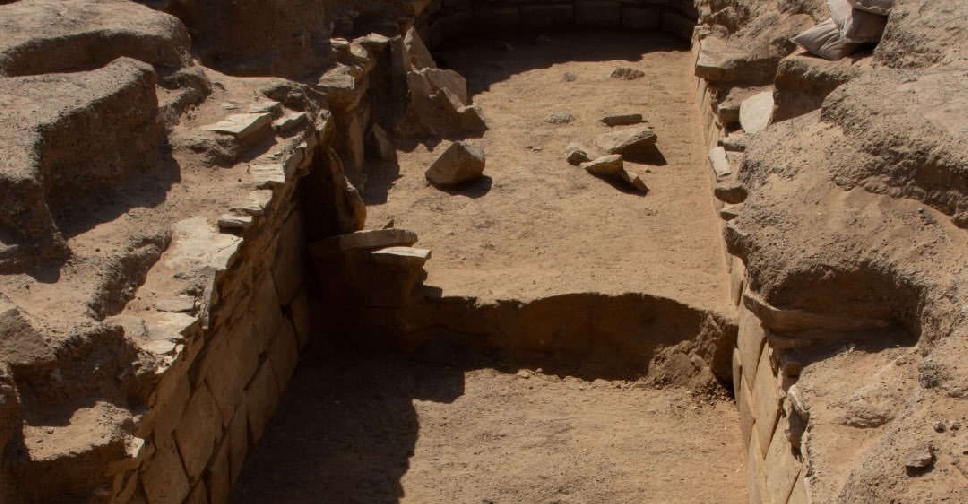
A cemetery dating back to the large Wadi Suq era and the Late Bronze Age (c. 2000-1300 BCE) has been uncovered in Al Ain Region, revealing new insights into the UAE’s history.
The discovery was made by the Department of Culture and Tourism – Abu Dhabi at the Pre-Islamic Qattarah Necropolis.
It offers significant insights into the enduring cultural practices and resourcefulness of ancient communities in the Arabian Peninsula.
The discovery also deepens the understanding of the region's ancient past, strengthens cultural identity and underscores Al Ain Region's importance as a UNESCO World Heritage Site.
The Qattarah Necropolis, known for its rich archaeological landscape, has yielded various discoveries over the years, including earlier Wadi Suq to Late Bronze Age communal tombs, Iron Age individual shaft-tombs and Late Pre-Islamic tower-tombs.
The recently excavated tomb is notable for its exceptional state of preservation and its unique construction, primarily from repurposed ashlar blocks sourced from even older Umm an-Nar funerary monuments (c. 2700-2000 BCE).
"Discoveries like these underscore the magnitude of our cultural legacy and the importance of our commitment to its preservation and understanding," said Mohamed Khalifa Al Mubarak, Chairman of DCT Abu Dhabi.
.@DCTAbuDhabi has uncovered a Late Bronze Age tomb within Qattarah Necropolis in Al Ain Region. The discovery offers insights into the enduring cultural practices and resourcefulness of ancient communities in the Arabian Peninsula. pic.twitter.com/RPYAOyZpWC
— مكتب أبوظبي الإعلامي (@ADMediaOffice) July 16, 2026
Measuring around 11 by 2.5 metres, the underground chamber was used as a communal burial site for hundreds of people over at least a 1,000 years, dating back to the Wadi Suq period, and in use until the Iron Age period.
Archaeologists say its east-facing entrance potentially allowed the rising sun to illuminate its interior during ritual activities, reinforcing symbolic connections to renewal and ancestral reverence.
Weighing over 200kg and carefully shaped from an earlier monument, a stone door marked the threshold between the living and the ancestral world.
The tomb contained a collection of ancient artefacts, including vessels, weapons and personal ornaments, offering a glimpse into the established practices of its time.
These artefacts, alongside the human remains, are currently undergoing in-depth study by DCT Abu Dhabi’s archaeologists and osteoarchaeologists.
Modern analytical methods, including isotopic and a DNA analysis, are expected to provide groundbreaking insights into trade networks, daily lives, diets, health, pathologies, and migration patterns of these ancient populations.
The artefacts will eventually go on display in Abu Dhabi museums.

 Five UAE convoys deliver 617 tonnes of aid to Gaza
 Anwar Gargash reiterates UAE position on three islands
 UAE human rights body calls for safeguards in climate technology
 UAE and Kazakhstan expand cooperation in transport, energy and AI